Autonomous vehicles are arriving, but cities aren’t ready.
Ten years ago, cities were energized by the promise of autonomous vehicles.
In 2015, the buzz was loud. Cities ran pilots, hosted workshops, and published white papers. But the tech wasn’t ready.
Now the tech is real and scaling. But most U.S. cities have no AV strategy, no designated leadership, and no plan to respond.
In 2019, we surveyed 120 U.S. municipalities with populations above 100,000 and reviewed the plans of 25 major cities. Among those 25 cities, 64% didn't mention AVs in their comprehensive or transportation plans. Across our broader survey, 81% of planning and transportation officials reported that their municipalities had committed “little or no staff time” to AVs.
The prevailing posture was understandable at the time: wait and see what the feds or states decide.
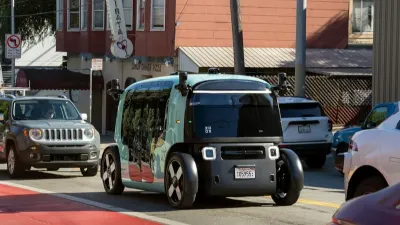
AVs won’t wait for permission. They are already arriving—on city streets, at airports, in commercial zones. They’re scaling rapidly, propelled by billions in private capital and real-world deployments in cities from San Francisco to Phoenix.
AVs don't just introduce another transportation mode. At scale, they touch some of the most important responsibilities of local government:
- Transportation: AVs alter travel patterns, induce demand, and reshape modal choices—may undermine public transit.
- Land Use: With reduced parking needs and new access demands, AVs offer more opportunity for densifying land use, better zoning, curb space management, and real estate investment.
- Data Governance: AVs generate high-resolution mobility data, but most cities have no standards for access, privacy, or accountability.
- Labor: They impact local driving jobs while creating many new ones without any city-led plan for economic transition or support.
Having no AV strategy means allowing operators, markets, and higher levels of government to make many of these choices first.
How can cities plan wisely?
I suggest a AV-READY Framework, a practical roadmap for cities to determine what they want from AVs, understand the powers they already have, choose policy instruments, engage operators, and build public legitimacy.
The AV-READY Framework
I think cities should organize AV planning around five questions:
1. RESULTS — What outcomes do we want?
2. AUTHORITY — What can we actually control?
3. INSTRUMENTS — Which policies should we deploy?
4. PARTNERSHIPS — How should we shape the market?
5. LEGITIMACY — How do we bring the public along?
1. RESULTS: Start With the City You Want
AV policy should begin with public outcomes, not autonomous vehicles.
In our review of transportation plans from 25 major U.S. cities, the underlying goals were surprisingly consistent:
- Livability: 100%
- Efficiency: 92%
- Environment: 88%
- Equity: 52%
cities often treat AVs as an “innovation” initiative rather than asking how the technology might advance or undermine these existing goals.
AV deployment isn't the objective. Better urban mobility is.
A city might decide, for example, that AVs should improve mobility for people who cannot drive, extend the reach of public transit, reduce parking requirements, improve late-night transportation, or provide better access to low-density neighborhoods.
Use AVs as Political Leverage
In 2019, we interviewed 25 municipal transportation and planning officials and asked them to assess the political feasibility of different policies both “today” and in a hypothetical future with widespread AV deployment.
The differences were striking. Political feasibility increased by 45 percentage points for congestion- and distance-based road pricing, 45 points for trip-data clearinghouses, and 70 points for eliminating minimum parking requirements.
technological disruption can create a window for changing policies that cities have struggled to reform for decades.
Parking is one example. Road pricing is another.
AVs aren't only a transportation technology. They can be political leverage.
2. AUTHORITY: Know the Powers You Already Have
One reason municipalities hesitate is the assumption that AV policy belongs primarily to federal and state governments.
Partly true.
Federal and state governments play central roles in vehicle standards, safety, emissions, licensing, and other aspects of AV regulation.
But AVs ultimately operate on the localstreet.
And cities retain important powers over how streets and transportation systems function.
Depending on state law and institutional structure, these can include:
- street and curb management
- zoning and land use
- police enforcement
- public transportation
- taxi and ride-hailing regulation
- data management
Before creating an AV strategy, cities should therefore conduct what I would call an AV Authority Audit.
For every major AV issue, ask three questions:
Who has authority? What authority does the city retain? Where does the city need cooperation from state or federal government?
That simple exercise prevents two common mistakes: regulating something the city doesn't control, and failing to use powers it already has.
3. INSTRUMENTS: Build the AV Policy Toolkit
Once cities know their objectives and authority, they can select actual policy instruments.
Our research identifies nine policies that municipalities can consider across three areas.
Land Use and Street Design
1. Reduce minimum parking requirements for new development.
If AVs reduce long-term parking demand, cities can reconsider how much valuable urban land must be devoted to storing vehicles.
2. Reduce curbside parking.
As transportation shifts from parking toward pickup and drop-off, curb space becomes an increasingly important public asset requiring active management.
3. Reallocate traffic lanes to walking, cycling, or transit.
If automation eventually improves road utilization, cities need to decide in advance who captures that capacity: more cars, or other urban uses.
Transit, Data, and Pricing
4. Integrate AVs with public transit.
AVs can compete with transit—or complement it through first/last-mile connections, late-night service, and coverage in areas where fixed-route service is expensive.
That outcome won't happen automatically. It has to be designed.
5. Establish a public AV data clearinghouse.
Cities need sufficient information to understand how AVs affect travel patterns, congestion, safety, accessibility, and public space—while establishing appropriate privacy protections.
6. Introduce distance- or congestion-based road pricing.
If AVs lower the perceived cost of travel and induce additional vehicle miles, pricing may become increasingly important for managing scarce road capacity.
Equity and Environment
7. Provide income-based AV subsidies.
If AVs become an important mobility service, cities can consider mechanisms to ensure affordability for lower-income residents.
8. Establish minimum service requirements.
Commercial operators naturally have incentives to serve the most attractive markets. Public policy can establish expectations for geographic coverage, accessibility, or service availability.
9. Require zero-emission AVs.
Automation and electrification are separate transitions. Cities should not assume one automatically delivers the other.
Not every city needs all nine policies.
The point is to connect three things deliberately:
Goals → Authority → Instruments.
That is the core of AV planning.
4. PARTNERSHIPS: Shape the Market Before the Market Shapes You
Besides Regulation, Cities can also convene, procure, contract, partner, share infrastructure, establish operating conditions, and design services with private operators.
That distinction matters because AV companies are moving much faster than traditional municipal planning cycles.
By the time a problem becomes obvious, operating patterns and consumer expectations may already be difficult to change.
Cities should therefore engage operators before large-scale deployment and establish expectations around issues such as data sharing, curb access, transit integration, accessibility, service coverage, and performance.
Different cities will choose different governance structures. Some may rely primarily on regulated private markets. Others may procure AV service directly for specific public purposes.
My own preference is generally a hybrid: preserve private-sector competition and innovation where markets work, while using contracting and public requirements where cities need to guarantee outcomes.
The public sector's job isn't simply to stop or permit new technology.
It is to shape the conditions under which the technology becomes useful.
5. LEGITIMACY: Bring the Public Along
AVs raise legitimate questions about jobs, safety, surveillance, accessibility, congestion, street space, and who benefits from public infrastructure.
Cities that engage residents only after decisions have been made shouldn't be surprised when residents distrust the decisions.
Public engagement should therefore begin early and address the tradeoffs directly.
-- Jinhua
Stay Ahead of What’s Changing Mobility
Get my memos, Mobility Forum conversations, and practical insights from frontier research and real-world practice.