Leading Utah DOT: Carlos Braceras on Innovation and Olympics
The Olympics forced UDOT to build faster, change travel behavior, and coordinate transportation as one system. The lasting achievement was a culture of innovation.
Listen to our full 48 mins conversation on Spotify or YouTube.
When Salt Lake City won the bid to host the 2002 Winter Olympics, the Utah Department of Transportation (UDOT) faced a challenge: 16 miles of I-15, built in the early 1960s for a 20-year life. A conventional rebuild would have taken about 10 years. UDOT delivered it in half the time and under budget.
To do so, UDOT leadership took a huge risk, betting on two innovations, design-build and best value, both common practice today but not back then. "It was scary as hell for the DOT," Carlos said.
But the most remarkable legacy of the 2002 Olympics is how UDOT has sustained the momentum for innovation long after the Olympics. In 2025 alone, UDOT implemented 80 innovations, with projected lifetime savings of $85.6 million from those with quantifiable benefits. "None of those came from leadership," Carlos said. "Those all came from the people on the ground doing the job."
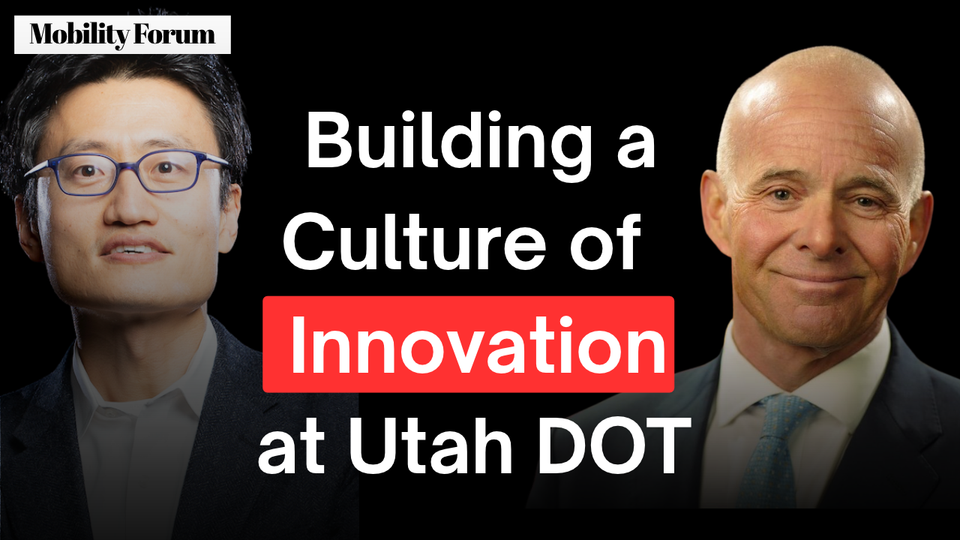
Over four decades at UDOT, Commissioner Carlos Braceras has built a culture where employees are empowered to experiment, dare to make mistakes and learn from them. At the Mobility Forum, I invited Carlos to share how he did it inside a government agency, where avoiding mistakes is often rewarded more than taking risks.
Here are the insights from our conversation.
1. Leaders Take the Biggest Risk: UDOT Bet I-15 on Design-Build and Best Value
At the time, I-15 was the largest design-build highway contract in the U.S.
The first was design-build: one team both designs and builds the road. The second was best value, or performance-based contracting: UDOT chose the team on quality and price together.
Carlos described the old way as "means and methods": the DOT told the contractor how many lanes it would take, even "how many rolls of a roller to get the compaction." With best value, "this is the performance we want," and the design-build team "came up with the design, came up with how they would build it."
Governor Mike Leavitt staked his reputation on it. He still marvels: "I can't believe I took that risk." For UDOT, it meant countless hours of one-on-one meetings to earn the trust of legislative leaders, and "a lot, a lot of sleepless nights."
2. Best Value Needs Judgment, and Judgment Needs Trust
Best value was the harder sell. "The easiest way for us in government to say, well, we picked the low bid. That's a pretty easy mathematical equation for us to show, and it gives us a great deal of cover."
Best value takes judgment: "you're evaluating the quality in a proposal, and then you're trying to bring that together with price." "There's a lot of trust you have to build to be able to bring it together, because you're not picking low bid."
UDOT still earns that trust in the open. On a $3 billion road project this fall, a state legislator sat in as a process witness to watch the technical scores merged with the price.
From a layperson's point of view it is common sense: you don't want the cheapest doctor to operate on you. But in the public sector, changing that is a big deal.
It also meant bringing the construction industry along. When UDOT later moved to construction manager/general contractor contracts, a large highway contractor looked Carlos in the eye and said, "You're changing the game on me." The lesson stuck with him: "You can't change faster than the industry is willing to change with you."
3. Reshape Travel Demand
To handle the 2002 Olympic traffic, UDOT asked employers to let people work remotely, set up regional sites outside the Olympic ring, and stay out of downtown during the Games, at a time when remote working was not yet normal.
UDOT's push worked so well that it caused a complaint. Halfway through the Games, the mayor of Salt Lake City called Carlos: "Carlos, I've got empty parking spots down here. Quit scaring people away from downtown." Carlos told him downtown had "10 times more than you've ever had before," and the empty spaces were "absolutely a success. It means they're coming in transit."
The mayor's reaction was the usual one: "They looked at a parking spot, and they thought, that should be full." Changing that expectation takes the whole system, roads, transit and agencies, working as one.
4. Operate Roads, Transit and Agencies as One System
For a DOT, operating one system was a new role. "We plan, we design, we construct, and then we start maintenance. And that was our cycle of life at the DOT." Getting ready for I-15, UDOT went to every city in the county and offered to pay to connect their signals to its system: "let's operate this as one system."
Connecting those signals started something bigger. Today, "we have probably 98% of every signal on the same fiber optic backbone, coming back to our Traffic Operations Center."
So UDOT put empty conduit into every project around the state. "We think fiber is going to be important in the future, even though we can't hook it to something now." Over the years, "we basically built a fiber system, a fiber backbone across the entire state."
That backbone now serves far more than traffic signals. It connects rural communities, "their libraries, their schools." And UDOT uses the spare capacity "as currency" in a "value-for-value exchange" with private broadband providers.
Carlos emphasized the hardest part: "It's really the people-to-people, the organization-to-organization, working together. That is the piece that takes the most time, it's the hardest."
The Games came five months after 9/11, and security pushed everything farther out. Armed FBI agents sat "in the backseat of every helicopter, because we had traffic engineers and helicopters above the events." His lesson: "If you don't have law enforcement as your partner in the operations with the same goals, you're not going to be successful."
UDOT staff worked alongside Utah Transit Authority staff and the Olympic organizers: "They had different jacket colors, but we were all with the same mission." Carlos counts those relationships among the greatest legacies of 2002.
The Games come once a generation. Many agencies innovate during the Games, and then the momentum dissipates. Not at UDOT.
5. Make Efficiency a Reward for the Teams
The public hears "efficiency" and says, of course, be more efficient. For staff, efficiency is a dangerous word: it means a budget cut, or even my job.
So picture the team that innovates. It finds a better way and saves money, and its reward is a smaller budget. After that the team is done innovating.
Carlos has three answers.
Give innovation a why: the $6 million mandate. The why goes back to the deal that paid for I-15, "our origin story for innovation."
To fund I-15, plus 42 other projects legislators added to the package, a program of nearly $3 billion, Utah raised the gas tax, doubled the vehicle registration fee and authorized bonds.
In return, the legislature told UDOT to put "skin in the game": find $6 million of efficiencies every single year out of its operations budget, for 20 years.
"We quickly ran out of $6 million a year of efficiencies. I'd be down to 10 people in the organization by now."
But the mandate gave UDOT its why: "You always have to lead with, why do we need to be innovative?"
Today the why is growth. Utah's population has grown by more than half since 2002, and "we can't keep doing things the same way we're doing them today."
Let teams keep their savings. If "you start taking money from your program that came up with a new and better way to do it, you're gonna shut down innovations right away." So at UDOT, the team keeps the savings and uses them for work it couldn't get to. Carlos even sees a blessing in tight budgets: "Government should never have as much money as it thinks it wants. We should be forced to make hard choices."
Elected officials will still want the money back, so UDOT tells them what each saving bought: "You have to complete the story."
Recognize the people behind innovation. Carlos reads about each innovation and personally writes hundreds of thank-you notes each year. "I get done with that, and I feel so good. I was like, wow, look what we're doing!"
It was his daily dose of joy.
Sometimes the thank-you is simpler still: for a maintenance crew that found a safer, faster way to put up wildlife fencing, "just going out there and buying them a couple sandwiches, and sitting down with them and saying thank you."
6. Make Innovation Everyone's Job, and Give Everyone Permission to Make Mistakes
Carlos knows what he is up against: "the way you don't make a mistake is you always do things the same way you always have done them."
His answer is the title of his article, "Go Ahead and Make Mistakes": "The only people who don't make mistakes are people who don't do anything."
Give employees permission to experiment. Carlos's promise to his people: if mistakes were made, "and they were done carefully, … we always have your back." "All successes belong to the people. All failures belong to me."
Let the front line lead. Frontline staff come up with the ideas. The innovation team just clears small blocks for them, like lending a coder for half an hour.
Among UDOT's 80 innovations:
A Right-of-Way Review Tracker cut legal review of land-acquisition documents from 45 to 21 days on average.
Set up a dedicated Emergency Coordination Center for emergencies and large-scale events, co-located with the Department of Public Safety's call center.
Installed 16 remote avalanche-control towers in Little Cottonwood Canyon.
With Colorado and Wyoming, won a $20 million USDOT grant to send connected-vehicle safety messages along 1,200 miles of interstate.
Spread ideas through the people who had them. UDOT has 90 maintenance stations. When one comes up with a good idea, "let that maintenance station employee, who probably never gets to travel, let them go around and explain to the other 89 maintenance stations what they did."
Apply the same culture to AI. AI moves faster than any procurement cycle or strategic plan. Utah state government went from an edict to every agency, "you will not use AI," to "go, go, go. But be careful," in a single year. UDOT's question was how to be careful "but also unleash the potential of people. And I'm not calling it the potential of AI, I'm calling it the potential of people."
"As soon as you become an agency that is prescriptive, that tells people how to do things, because we're afraid of making a mistake, you shut down."
So UDOT built its AI principles on the agency's three values: integrity, "you do the right thing even when it's hard"; respect, "even if you disagree with them"; and caring, "you care about people as people." "As long as you operate within those three values. Got your back."
Then it let staff find the uses themselves, and "we're seeing things happen that, you know, I wouldn't have dreamed of."
For the uncertainty that any innovation brings, Carlos goes back to a childhood memory. One afternoon in Verona, New Jersey, his mother took the training wheels off his bike and ran beside him, hand on the back of the seat, saying "Faster, faster, faster." Whether it is a bicycle, AI or anything else, "we need to keep moving forward with speed as an organization in order to maintain that dynamic stability."
The 2002 Games changed how the outside world sees Utah and, more importantly, how Utah sees itself. "Now we kind of know we can do this," Carlos said. With the Olympics returning in 2034, Utah has an opportunity to apply these lessons to a larger, more complex system, with a new generation of technologies.
Carlos once gave the Utah Legislature a line: "A mistake that's shared is an opportunity. A mistake that's kept secret is a failure."
Listen to our full 48 mins conversation on Spotify or YouTube.
– Jinhua
Stay Ahead of Changing Mobility
Get my memos and mobility forum episode on practical insights from frontier research and real-world practice.
You might also like
Oct 31
Reinvent Customer Experience at Washington Metropolitan Area Transit Authority
When Randy Clarke took over Washington Metropolitan Area Transit Authority (WMATA) in 2022, it faced a $750M deficit, two-thirds
2 min read
Oct 12
Making AI Work in State DOTs
Lessons from California, Texas, and Utah
5 min read
Oct 03
3 Levels of Action To Make AI Work
Individual Productivity | Project Teams | Organizational Change
9 min read
Sep 23
New Generation Activity-Based Travel Demand Models: From Trips To Lives
A new generation of travel demand modeling is pushing toward much greater behavioral detail
11 min read
Sep 20
Two Types of AI in Transportation: Fantastic AI and Grounded AI
What Transportation Professionals Should Learn and Do Now