Making AI Work in State DOTs
Lessons from California, Texas, and Utah
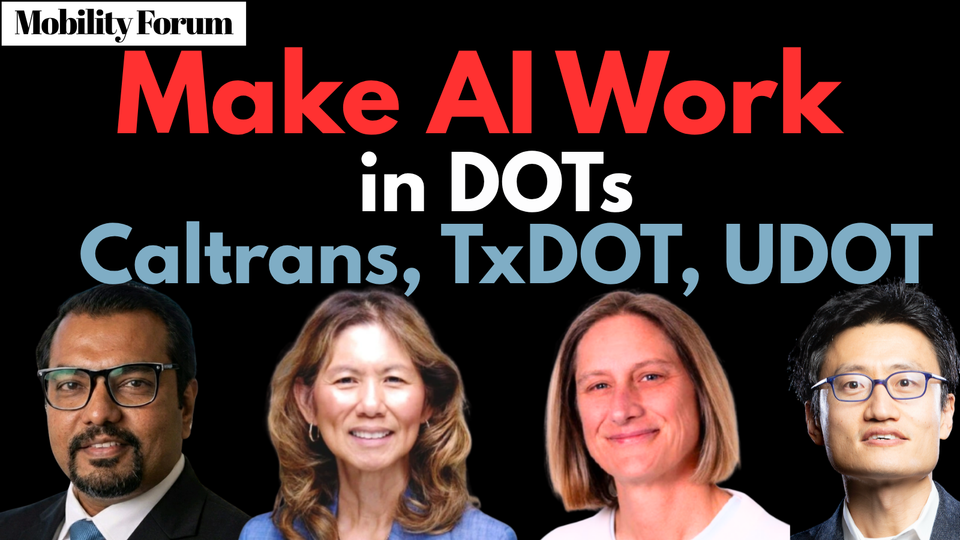
Last Friday, I brought together three state DOT AI leaders, Vidhu Shekhar of Caltrans, Anh Selissen of Texas DOT (TxDOT) and Jennifer Volkening of Utah DOT (UDOT), to explore what Grounded AI looks like in practice.
All three DOTs have moved past demos. They are working together through a pooled-fund effort and adoption council with other 20+ state DOTs to compare AI strategies, roadmaps, ethics and best practices. The next step is to move from sharing lessons to sharing tools, algorithms and platforms.
Here are the four takeaways. (click here to listen to the full 48 min episode).
TxDOT collected more than 200 AI ideas and ranked them by business value with a use-case scorecard that weighs ROI, data, security and privacy, and ethical and legal risk. One early success is invoice processing: the AI reconciles contractor invoices with purchase orders so staff review only discrepancies. A routine invoice that took about three weeks now takes about 30 seconds. Faster processing has saved $200,000 in penalty interest so far; contractors get paid sooner and projects move faster.
Anh said: “None of that is sexy, but it has high business benefit and low risk.” Chief Executive Director reviews the agency’s AI use cases with the team every month. Twenty-two are in the next round of projects.
Caltrans is testing AI-timed traffic signals on State Route 68 in Monterey County can cut travel times about as much as a far more expensive infrastructure project.
This one-year pilot began in February, and Caltrans has a rigorous plan to test it with results soon.
Caltrans’ Road Safety Insights began as one use case and grew into a platform. New modules, such as work zone safety and project-delivery cost estimation, plug into the same data. UDOT has just kicked off its own version.
UDOT started from an everyday question employees kept asking: where is the policy on this, and what is the procedure for that? It built a policy search bot in house. Staff ask in plain language, and the bot searches a curated set of current policies and procedures, answers, and links to the source document.
It is a small project, but it stuck. “It’s not one of those things people started to use and then stopped using,” Jennifer said. Executives like it most. They “have a hard time remembering where the policy was that had the one little sentence they’re looking for.”
Reference:
The consensus across all three agencies is: keep a person accountable for every AI output.
Caltrans works by a principle: “AI-generated insights, human-generated judgment.” Its Road Safety Insights platform produces corridor-level safety analyses. A safety engineer reviews the content and the sources, then signs off. For Caltrans, it’s not just about the human in the loop. But it’s human approval at the end of the loop as well.
TxDOT operates under a similar philosophy: “Human-led, AI-supported.” No invoice is paid until a person has checked it. The accountability is still on staff as AI is not the one making the decision.
UDOT shared a cautionary tale. When AI meeting notes were switched on across Utah state government, transcripts went automatically to everyone on the invite list, including from meetings where the recording was left running during sensitive conversations. The state paused the feature until the meeting organizer could vet the notes first. The lesson is keep a person at the gate before something is handed off.
AI makes analysis cheap. Someone still has to check it and sign it. Transportation already has a tradition for this: the engineer’s signature and seal. State engineering boards hold the engineer responsible for the work product, with or without AI.
Here is how the three agencies check AI output:
DOTs have talked about data integration for decades. AI changes it in three ways. It pulls structured, unstructured and geospatial data together, so documents now count as data too. Every answer has to trace back to an authoritative source, or no one can sign it. And errors surface: a bad record can sit unnoticed in a database for years, but a wrong AI answer built on it gets noticed.
Caltrans pulled together about 10 terabytes of data from 30 different systems. AI really puts a microscope on that data. The harder job was making sure each dataset is the approved, current version. Only that version can enter an AI system, and every output traces back to it. Geospatial data needs extra care. LLMs are trained on language, and their spatial intelligence still lags behind.
TxDOT starts from the base layer: security, data privacy, and an enterprise data platform it has been building for more than five years, including GIS and spatial data. It is now refining the platform’s metadata and working with Esri so AI tools can work directly with GIS layers. AI is feeding on data. The better information you give it, the stronger and the more intelligent it’s gonna be. TxDOT’s scorecard for new use cases puts data readiness right next to return on investment. A use case can promise a big payoff on paper, but without the right data, it doesn’t matter what ROI you have.
UDOT’s policy search bot ran into the same problem. In beta testing, the most common question was: “How do I get my boots reimbursed?” The bot could not answer it. The answer sat in a procedure rather than a policy, and the bot searched only policies. UDOT added procedures to what the bot searches.
A second problem followed. When a policy was updated, the old version often stayed in the repository next to the new one. The bot could not tell which was current, so it would “pull up both the old one and the new one,” and staff were confused about which rule applied. UDOT’s legal team owns the repository. It now moves every repealed or replaced policy into an archive that the bot does not search. That step did not exist before, and it is still done by hand.
Every DOT faces the same problem: districts and headquarters often maintain their own versions of the same documents. Solve this problem in one state, and the approach could become a model for every DOT across the country.
You can build 90% of an AI tool quickly. The last 10% (old versions, misfiled procedures, verifying every source) takes much longer.
When engineers are accountable for reviewing AI’s work, the ultimate quality of the work still heavily depends on an individuals' expertise and execution. Transportation domain knowledge and expertise becomes more important as AI becomes more capable, not less.
UDOT has invested in an agency-wide learning process. That includes regional discovery visits, foundational AI workshops, practical demonstrations, and “Shift to AI” webinars.
TxDOT is building skills from the bottom up. After rolling out Copilot and Gemini, it is providing the training and everything to get them competent. Now districts and divisions build their own agents and come to IT asking how to promote that into a wider adoption agent that people can use. The hope is a repository of different agents for TxDOT.
AI is a great tool. But a tool is only as good as the people using the tool.
The greatest return on AI investment does not come from acquiring better tools, but from developing more capable people. AI literacy, professional judgment, and the ability to redesign workflows are becoming essential competencies for transportation professionals.
Listen to the full 48-minute conversation on Mobility Forum Podcast:
-- Jinhua
PS: I’ve received great interest in the AI Fundamentals for Transportation Professionals workshop. If you want to join the interest list, click here.
Get my memos, Mobility Forum conversations, and practical insights from frontier research and real-world practice.