Making AI Work In DOTs: 3 Levels of Action
From Individual Productivity to Project Teams to Organizational Change
In AASHTO's 2025 survey of state DOTs, 79% of respondents named training as something that would help them adopt AI. They named it more often than funding (67%) or pilots (61%).
But training in what?
AI tools change every quarter. What lasts is what a transportation professional can do but AI cannot.
The question has moved from "how good is the AI?" to four others: What task do we delegate to AI? Who checks it and signs for it? How do we build trust? What do we benchmark? Professional judgment does not disappear. It matters more.
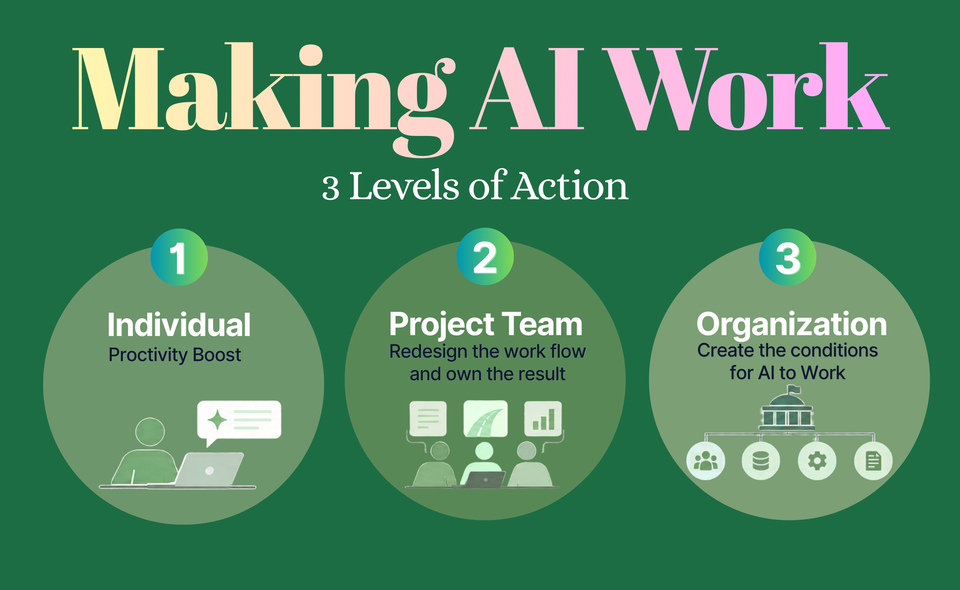
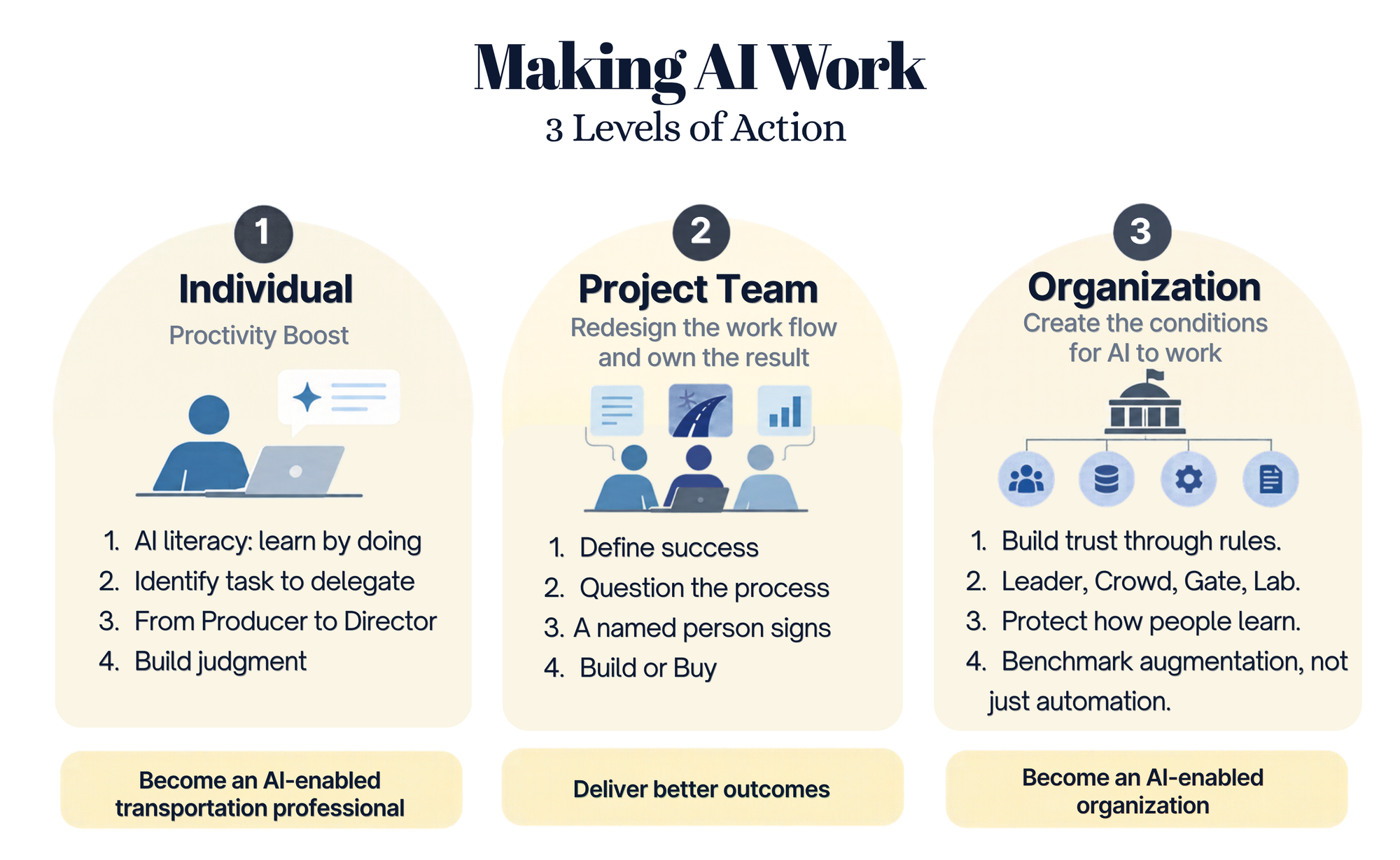
Transportation professionals cannot wait for a perfect AI strategy or the next generation of tools. Start building the professional judgment and capability to use AI now. I suggest 3 levels of action.
Level 1 starts with individual staff. Level 2 is a project team. Level 3 needs the DOT c-suite to change how it decides, trains, and measures.
Any task has three parts: define the objective (the director), do the work (the producer), evaluate the result (the critic).
AI may do the work. Defining the goal and judging the result stay with you. The transportation domain, not the AI, defines what a good result is.
1. AI literacy: learn by doing.
The reward is immediate: two hours of learning AI can save you time every day, starting next week. Start small. Build a tool for your own work, using the AI your agency has approved and material that is already public record.
2. Identify which task to delegate to AI
Start with tasks that are routine, well defined, and easy to check: a first draft of a staff report, a summary of public comments, cleaning a public crash dataset, a simple analysis script. Keep the tasks that need your context or your signature: setting the goal, reading the room, choosing among options, signing the result.
If AI can do 50% of the tasks in a job, the rest, which only you can do, becomes more valuable.
3. Change your role: from producer to director and critic, and to communicator and negotiator.
Once you have directed and judged the work, you explain it to others and get the stakeholders to agree.
4. Build judgment. Becoming an AI-Enabled Transportation Professional
Ask AI for ten ideas: one is excellent, three mediocre, six garbage. Your expertise is knowing which is which. The reason humans keep that job is our long "context window": years of experience, the unspoken cue in a room, the local culture of this agency. AI knows only what it is given. Domain expertise and institutional knowledge become more important, not less.
Where do judgment come from? They come from practice, and AI cannot practice for you.
Three Pitfalls to Avoid
Pitfall #1: AI can harm learning.
Students who used AI to scored higher on practice problems but learned less, because the AI did the thinking. A tutor version that gave hints instead of answers largely avoided the harm. The same holds at work. Learning takes struggle. Remove all the friction and you remove the learning too.
Pitfall #2: AI hallucinate.
Check what the decision rests on: the numbers, the sources, the references to codes and standards. Accountability stays with the person who signs.
Pitfall #3: Your prompts and AI outputs may become public records.
In a public agency, if what you type into AI, or what it gives back, is used to conduct agency business, it may be subject to public records requests and to the agency's retention rules, like an email. It may also come up in a lawsuit. The rules differ by state, and many are still being written. Ask your records officer which retention schedule covers AI prompts and outputs.
Two practical rules. Write every prompt as if it could be read aloud at a public meeting. And do not put into an AI tool anything you would not put in a public document, such as personal data, bid information, or security details, unless your agency has approved that tool for that data.
AI has made some of the work much earier: spotting, measuring, finding, and first drafts. It has not made deciding easier. The bottleneck has moved from producing to checking. Owning a result means checking it and answering for it.
3 cases show how AI changes the work.
Case 1. Finding dangerous highway locations for people walking and biking, before the next crash — Caltrans (generative AI pilot, 2024–25)
About 12 Californians die on the roads every day, and Caltrans aims for zero deaths by 2050. Its safety program finds the worst locations and fixes them. In 2024 it tested generative AI from Deloitte and INRIX on this work.
Before AI, a location got attention only after people were hurt there. The AI combines crash data with near misses, traffic, bike and pedestrian volumes, and equity data to flag risky places before the next crash. It suggests treatments and drafts the concept report in hours instead of six to eight months (the vendor’s figures). Engineers still visit the site, choose the treatment, and rank projects for funding.
Case 2. Finding freeway crashes and stalled cars sooner — Texas DOT’s Austin District traffic management center (AI incident detection, piloted 2022–23, statewide contract since 2025)
Before AI, most highway incidents reached Austin’s traffic management center through 911 calls and police dispatch. Texas DOT bought an AI tool from Rekor. It combines connected-vehicle and other data, and alerts operators to crashes, stalled cars, and debris. An operator checks each alert on the nearest camera and decides whom to send. Every step after that stays the same. Texas DOT reports that 34% of incidents were found only by the tool, and that the tool found incidents 11 minutes sooner at the median (Arellano, TxDOT, 2023). Operators could not confirm about 3 in 10 of the new alerts. From past studies, Texas DOT also estimated a 29% lower chance of secondary crashes. That is an estimate, not a count. Texas DOT’s AI strategic plan calls Austin “a blueprint for statewide district expansion”.
Case 3. Finding the right policy with an AI search agent — Utah DOT’s Data Analytics and Governance team (built in-house, in use since about 2025)
Utah DOT asked its staff what hurt most. The top answer was: “Where do I find the thing I’m looking for?” The agency’s data team built a search agent in about four months. Staff ask a question in plain language, and it answers from the agency’s policies and procedures. The employee still judges whether the answer applies. The first version covered only policies. Testers at once asked how to get their boots reimbursed, which is a procedure, and it failed. Procedures were added. Two versions of a dress-code policy gave two different answers. The lesson Utah DOT drew: each set of documents needs an owner and one current version. It has been in use for about a year and a half. Utah DOT has not published how often it is used or how often it is right.
What the comparison shows:
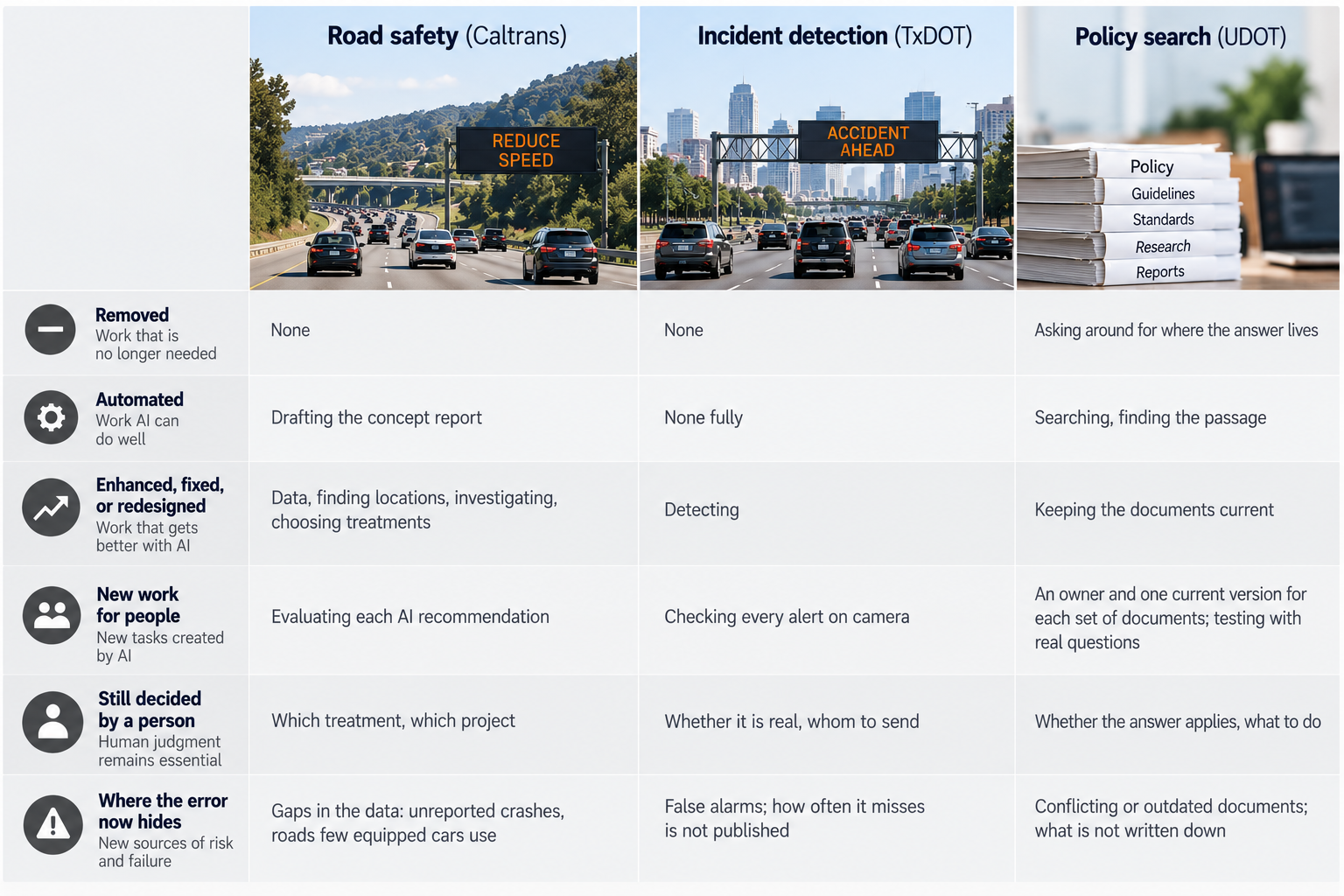
Six things a team has to do to own the result when AI does part of the work. They work best in this order.
1. Define what a good result is, how you will measure it. Decide: who should benefit, how many wrong results you can accept, and who pays for them.
If time saved is the only measure, the fastest tool wins, even when it is less accurate. In the VDOT study, full automation saved time but lost accuracy. The study could see this only because it measured accuracy as well as time. Utah DOT has not yet published how often its search agent is right.
2. Question the process before you automate it.
Remove what is useless. Simplify what is complicated. Do not automate useless steps. Otherwise AI will run the old waste and the old biases, only faster and harder to see. Sometimes fixing the process means redesigning it, not only removing steps. At Caltrans, AI is what made it possible to look for risk before the crash, not after. Removing useless steps is the team’s job.
3. Get the data ready.
The team owns the data AI works from. Incomplete or biased data gives incomplete or biased answers.
4. Decide where AI works, where a person decides, and who signs.
For example: AI drafts, a person chooses, AI refines, a person verifies.
Each hand-off is a point where a person can still say no. Put these points where a mistake would otherwise go unnoticed.
For the check that must not fail, the person looks first, before seeing the AI's answer. Otherwise people stop looking for what the AI missed.
At Texas DOT, operators check each alert. How often the AI misses an incident is not published. In that case, also check a small random sample of what it passed over, to count what it misses.
The O-ring rule: when AI does most of the work, one failed human check can bring down the whole piece of work (Kremer 1993; Gans and Goldfarb 2025).
The closer the output is to the road, the stricter the check:
Who signs. A named person signs for the result.
When several agencies and a vendor share a process, name one owner. The tool for this already exists: the engineer's stamp. It is the most common way state DOTs govern AI (AASHTO). Few licensing rules yet say what the stamp requires when AI helped do the work.
The state licensing board sets what a stamp means. But the DOT can act now. Its QC manual and its consultant contracts can require a record of which AI tool helped and how the engineer checked the work. A signature means something only if the signer could actually check the work. Design the workflow so they can. Write down how the work will be checked before you issue the RFP.
5. Build or buy, and select the vendor.
AI moves the line between what the agency builds and what it buys. Building is cheaper now, so more can stay in-house.
Utah DOT uses four options: use an existing vendor tool, build it yourself with simple tools, ask the agency's internal lab, or hire a vendor. A fifth option keeps the most skill inside the agency: the vendor builds, and the agency owns the design. Utah DOT built its search agent in-house. Caltrans and Texas DOT bought from vendors. When you buy, write the test into the solicitation: a paid proof of concept on your own data, against your own measure of a good result. Before you sign, secure three things: the data stays yours, the method is visible, and the tool can show why it said what it said.
Whoever builds it, your team must be able to check what it produces, and the agency answers for it.
6. Pilot, Measure, Scale.
Start with one district or one route. Measure result, not on how new the tool is. Scale up only if the result holds. TxDOT compared every method with the tape measure.
Teams own each result. The DOT sets the conditions: the rules, the people, and what gets counted. The DOT controls its workflows, QC, contracts and training. Here are 4 ways DOT leaders can create the conditions to make AI work.
1. Build trust through rules.
Whether AI gets adopted is mostly about whether people trust it, not about the technology. An AI system cannot build trust in itself; a leader has to. Start from an actual problem, not from a tool: what problem matters, what decision must improve, who will act, who is accountable. Then explain what the system does, and ask users whether it helped.
Caltrans, TxDOT and UDOT all has an Chief AI officer. They set up a review group: Texas DOT’s includes legal, HR, and internal audit. They made a deal with staff and unions: MinDOT told the public where AI is used. New Jersey, for example, requires this statewide for AI that serves residents.
The leader can set the culture. Carlos Braceras, executive director of UDOT, fosters a workplace culture where staff are encouraged to view mistakes and failures as valuable lessons rather than things to hide.
2. Leader, Crowd, Gate, Lab.
The leader gives permission and mandate . The crowd is all staff; they know which processes are broken. The lab is technical team that builds the fixes. It can be internal data team, or outside vendors, universities or the state IT agency. The gate is between the crowd and the lab. At Texas DOT, a readiness scorecard screens more than 200 candidate uses on data, a sponsor, resources, and risk.
A mandate with no lab only produces strategies; a lab with no mandate produces demonstrations.
Poor data is the top barrier in the AASHTO survey (76%). Texas DOT first built one data platform from 51 sources.
The lab can start outside the DOT. Caltrans used vendors. Massachusetts DOT used university students, then grew its own team from 2 to 8.
Another barrier is the wish to normalize AI. AI is weird. It needs organizational experimentation, and leaders willing to ride the J-curve: a temporary dip before the gain.
Caltrans, TxDOT and UDOT now have a leader and a gate. Nationally, AASHTO counts about 20 states with an AI plan or policy.
Staff have plenty of ideas. Data decides which go ahead. TxDOT staff gave more than 500 ideas. They became more than 200 candidate uses. About 36 are done, under way, or planned. The filter was ready data and a sponsor.
3. Protect how people learn.
Apprenticeship used to play two roles: the junior did the work for the senior, and the senior trained the junior. Both benefited. There is a risk of an apprenticeship crisis: delegating the grunt work to AI agents removes the path by which juniors become the senior. AI removes the tedium but also the opportunity to learn.
Even if AI can do the working half, we need to preserve the training half. Otherwise, in ten years, no one is qualified to sign.
In a DOT this collides with the retirement wave and the years of supervised experience engineers need before a PE license.
In the DOT cases, retirements are the pressing problem so far. Massachusetts DOT built an AI assistant, HEKA, to pass senior engineers’ knowledge to new hires. Utah DOT’s search agent now answers what new staff used to ask a long-serving colleague. That saves time. It may also remove a conversation where juniors learned. None of these DOTs yet tracks whether juniors still learn when AI does their first drafts.
The remedy follows from what made the junior competent: not the tedious work per se, but doing the work and having a senior check it. AI can take the volume. The junior still does a checked share of it by hand; that share, not the tedium, is what trains them. Three remedies: intentional friction, AI-free zones, and formal assessment. In a DOT, that means: give seniors a timesheet code for the hour they spend reviewing a junior’s work; ask for a learning mode, where the junior tries first, in the next AI procurement; require the consultant's QC plan to say how its engineers-in-training had their work reviewed.
4. Benchmark augmentation, not just automation.
Automation measures saved hours. But it should not be the only benchmark.
Decide in advance where saved hours go, and tell staff and the union. Otherwise staff may stop reporting savings.
Where DOTs count anything, they count hours: 1,300 hours in Caltrans’s Copilot pilot, 22,000 staff hours a year on Texas DOT’s invoices. Many are self-reported. In Pennsylvania’s statewide pilot, 175 volunteers estimated they saved 95 minutes a day.
Outcome measures would be the strongest, but they are rare. Texas DOT estimated, from past studies, that faster detection in Austin could lower the chance of secondary crashes by 29% (TxDOT 2023). That is an estimate, not a count. The MTA does count outcomes: bus speeds and collisions, from every trip.
Augmentation measures how much more capable the staff become, and that is much harder to measure. Count what you already can: alternatives considered per study, errors caught in review before they reached the road, engineers-in-training progressing to sign. We still need significant progress on the measurement science of capability increase.
Develop more capable staff; then service quality follows. The same team considers more alternatives, catches a problem sooner, judges better, and more of them become people who can sign in the future.
Each level depends on another. Level 1 depends on Level 3: without the DOT's mandate and tools, staff are learning on a consumer app, away from the real work. Level 3 depends on Level 2: without a team that defines a good result, leadership has only hours to count. Level 2 depends on Level 1: without individual staff's judgment, the team has no one who can check the work.
Transportation professionals cannot wait for a perfect AI strategy or the next generation of tools. Start building the professional judgment and capability to use AI now. Directing and judging stay with you. Keep the people who can sign, at every level.
AI can generate options. It cannot decide what transportation future we should build. That remains our job.
—Jinhua
Get my memos, Mobility Forum conversations, and practical insights from frontier research and real-world practice.